Sunday, February 22, 2026

2014, Part 1

I started writing this blog in 2013. In the spring of 2013, I started a Master's degree in Social Work. Because of what happened with my shunt in 2009, I decided to stay 1 to 2 months ahead of my homework assignments out of paranoia. This way, if I needed surgery and/if would be out of school for 3 weeks I would at least be caught up by the time I returned to school.

In August 2013, I was standing up and felt a vibration throughout of spinal cord and head. I almost fell on the floor. This only happened once. The vibrations in my head continued though...

I saw Dr. I and told him about this and he said the following:

'"If it continues to happen in December, we'll fix it." 

Now he was having me do a X Rays like every three months. I'm surprised I didn't glow green from the radiation. 

At that time I was starting to loose my appetite.  

Anytime you have a lack of appetite and vibrations in your head and you have a shunt it is a medical emergency. Why? Because it means the shunt could be broken. 

I had more tests done and Dr. I didn't know what to do.

In the middle of February 2014 I had an MRI  because things were getting worse.  The radiologist had mentioned there was a 5ml stroke developing on the right side of my brain. I didn't know this at the time.

When I saw Dr. I again at the end of February, I had insisted that I needed surgery. 

VB:" I need to have a full revision. It's suppose to go on the right side."

*I had never had this thought prior to seeing him, I just blurted it out. I suspect it was divine intervention or my late grandmother whispering in my ear or something...

Dr I - "It is on the right side."

VB: "No it isn't. You need to fix that."

Remember, in 2011 Dr I had moved the valve to the right side and left the distal catheter on the left side.  

Dr. I - "I've done a million of these surgeries and I know when shunts aren't working." 

VB: "I'm sure you're very good at what you do. I've had this in my body since I was a baby and I know when it's not working and you need to fix it."

More divine intervention. 

Dr. I - "You could have a stroke."

I realize now he was saying this because of the MRI results. 

VB - "That's the risk for any surgery."

Dr. I - "Ok. We'll schedule surgery for March 6." 

My mother and I had brought in my x rays from 1995 (I was 14 at the time) We wanted him to see them and as soon as we mentioned this he said:

Dr. I - I don't need to see those." 

VB and Mom: "What do you mean?!''

Dr. I - "I don't need to see those."

He literally put his hand up before we even took the x rays out of the envelope. Prior to the use of digital imaging -You were given the actual X Ray images on large sheets.  

Again, I realize Dr. I ( Dr. Incompetent ) didn't want to see them because had we been able to compare the 1995 images to the February 2014 ones it would have been obvious something was wrong.

When I was being taken into the operating room on 3/6/14 - I was talking to Dr. I for a few minutes asking about what everything looked like. He was confused as to why I would be curious about this. ( I didn't tell him or anyone I was making a short film about my shunt.) Next thing I knew - Everything went black. 

I suspect my shunt stopped working at that moment.  

Operative Report 

Date of Surgery: March 6, 2014

Preoperative Diagnosis: Ventriculoperitoneal shunt failure 

Postoperative Diagnosis: Ventriculoperitoneal shunt failure

Anesthesia: General Endotracheal Anesthesia

Estimated Blood Loss: 25 mL

Findings: Opening Pressure approximately 15 mm of water.  

Complications: None *This was not true as we will see later..

Procedure:

The patient is a 32 year female who presents with signs, symptoms and radiographic evidence of slit ventricle syndrome.  The patient had had increasing headaches and unchanged ventricular size on CT imaging.  The patient underwent ICP monitoring and was found to have no elevation ICP verses headaches. Given these findings, it was recommended that the patient undergo exploration of her VP shunt under presumed diagnosis  of a partial proximal obstruction.  

Anesthesia: The patient was sedated and intubated without difficulty by the anesthesia service. Eyes were taped shunt after ointment was applied to prevent corneal abrasion. 

Operative Technique:  

We first began by disconnecting the valve from the distal catheter. Once this was accomplished, a manometer was then inserted. Once this was accomplished, attention was then turned to the left frontal area, which was then opened sharply  with a #15 scalpel blade using a combination of blunt and sharp dissection as well as monopolar electrocautery. The left front bur hole was then identified. The ventricular catheter was then disconnected from the valve on the right frontal incision and minimal CSF was noted to be dripping. At his point, the neuroenddoscope was then brought into the field.  The NeuroPEN was then navigated through the left frontal catheter and was found to be stuck; however, the ventricular system could successfully be navigated. Once this was accomplished, it was noted. However, there was slow pulsation of CSF through this cathether. Given these findings, we decided to proceed with a right frontal ventricular insertion using an 8 drill bit, a burr hole was then created in the right frontal region. Once this was accomplished, the dura was then bipolarized and incised with a #11 scalpel blade. The ventricular cathether was then inserted to a depth approximatley 6 cm. Brisk CSF flow was noted upon entry. Next, the NeuroPEN endoscope was then brought into the field adn the ventricular system was navigated critical landmarks including the right sided choroid plexus. formamen of monroe, and septal epllucidum were identified.  The cathether was then inserted through the right formen of monro. The third ventricile catheter was left withing the third ventricle.

Next, the programmable valve was brought into the field along with a 10 cm anti siphon device. The valve was then connected to the distal cathether and then connected to the proximal cathether. The shunt was again tapped verifying the patency.  The wound was then copiously irrigated with an antibotic solution until clear. Both wounds were then closed with sequential 2-0 Vicryl suture followed by running 3-0 Monocryl suture for the skin. Sterile dressing consisting of Mastisol, Steri Strips, Telfa and Tegaderm and Coban was then applied. All needle counts, sponge counts and instrument counts were correct at the end of case x2.

Admitting Physician: Dr. I. 

Signed by Dr. G at 12:15PM. 

Dr. I had told my family while I was in a coma in the ICU that when they moved the distal catheter to the right side was when I had a stroke.  

This was not true.

Dr. G the other physician in the OR had written the following:

The patient is status post VP shunt revision with removal of the left frontal approach ventricular catheter and placement  of the right frontal approach ventricular catheter with tip near the froman of Monroe to anterior third ventricle, there is expected postoperative pneumocrephaly, intraventricolar air within the frontal horms of the lateral ventricles, and subcanous emphysema within the right frontal scalp, T=

There is a focal hemorrhage in the region of the left thalmus measuring 7x10 mm at the site of the tip of the prior ventricular cathether Acute 5 mm intraparenchymal hemorrage in the right paraedian pons has developed since 2/22/2014. The size and configuration of the ventricular system is similar to prior exam.  No hydrocephalus. no depressed calvarial fractures. 

Impression:

1. Shunt revision as described above.

2. Focal acute 10 mm hemorrhage in the left thalmic region

3. Focal acute 5mm intraparaenchymal hemorrhage in the right paramedian pons has developed since 2/22/2014. 

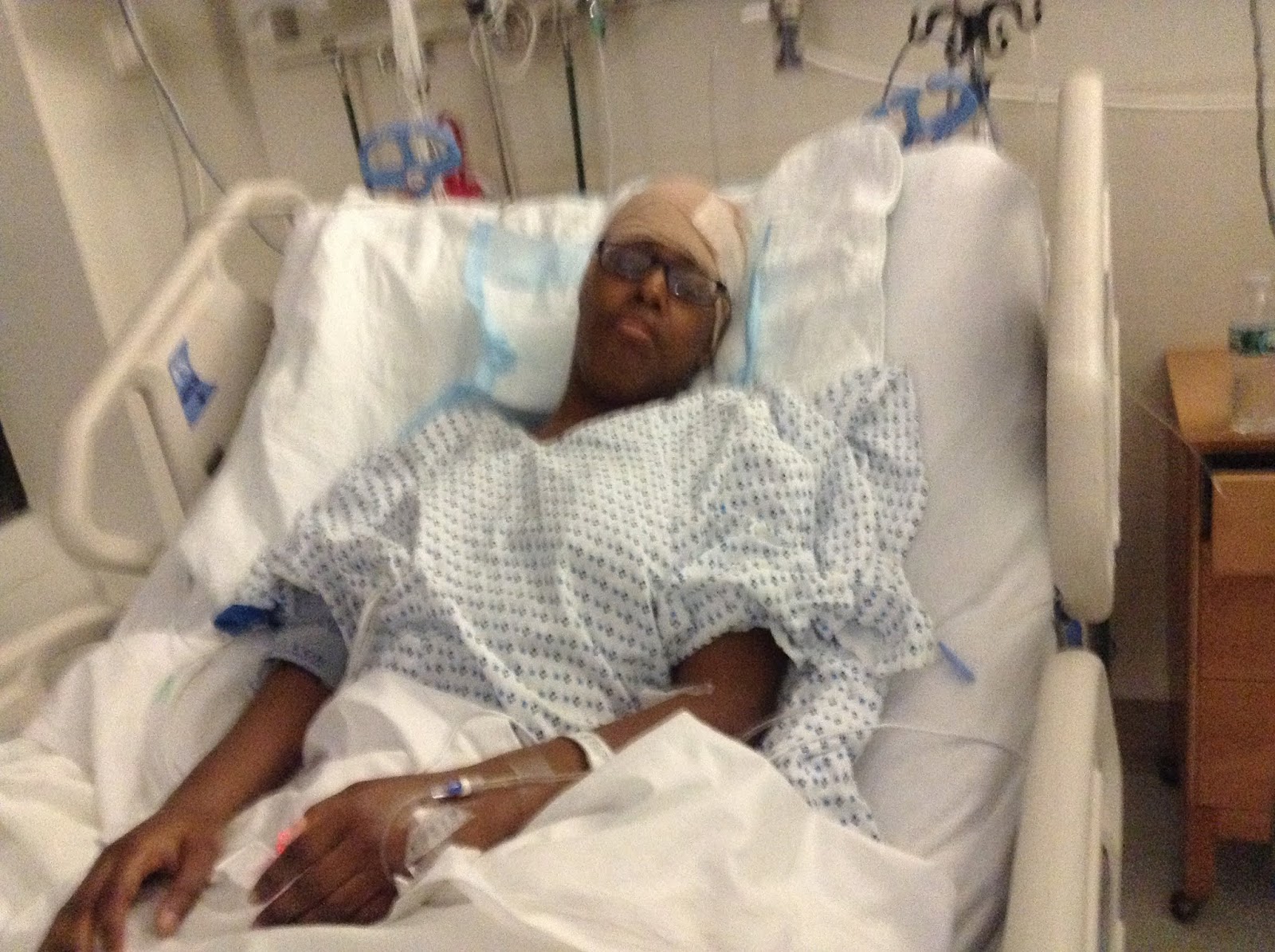
When I woke up in the operating room, my entire body was stiff and numb.  I thought when I died I would go back to a spaceship. (I like science fiction and I think I came from one.) Or I would see a white light or hearing music playing, maybe see a dead relative and there was none of that. I was just in this room with one eye shut closed. My right eye was pointed down and inward toward the inside of my left eye.  I was able to move it out a little before Dr I came to me and said "You had a stroke you're going to rehab."

 VB: (thinking) What?!

I was still confused about what had happened. I was trying to analyze the situation.

Moments later, my mom walked up to my left side and I told her the following:

VB: Everything is numb. Everything is numb. 

Then everything went black (again).

While I was in a coma....I saw all these pretty swirling colors of green, blue, pink and violet. I learned later those were the same colors in the machine I was hooked up to. 

Dr. I told my family the following:

Dr. I: "We did what you told us to do. At least she didn't have a stroke in her forehead."

Meaning that he was only following my instructions. Yes, having a stroke in my forehead (prefronal cortex) would have meant I wouldn't remember how to speak. 

Why would Dr. I tell my family and myself that I only had a stroke? 

I learned while in rehab, that I had multiple brain injuries during surgery...I would have surgery again in May 2014...


Sunday, January 25, 2026

2011

For about two weeks this month I had elevated pressure in my forehead and nausea from the shunt adjusting itself as it does at times. I also had a headache in the back of my head from the chiari malformation in addition to pain behind both eyes. Medication reduced some of the pain and then it just returned again. It's for this reason why I don't bother with pain medication unless it's really making me uncomfortable. 

Let's continue reading about my shunt revisions leading up to 2014:

In out last exciting adventure, I had surgery in 2009 after my shunt became obstructed weeks before I was to graduate with a Master's in Art Education. I started seeing Dr. I at a different hospital since Dr. RH never returned my multiple phone calls after I had experienced concerning complications post surgery. My shunt had been moved to the opposite side of my brain and I almost died. I didn't know at the time the shunt was on the wrong side of brain.

The morning of  February 16, 2011 my shunt became obstructed. The night before I had felt a pain behind my right ear which I had never experienced before and I didn't suspect anything. The morning of 2/16/11  I was unable to walk and I was vomiting everywhere. I couldn't lift up my head because of intracranial pressure.  I went to the emergency room for another shunt revision surgery:

Preoperative Diagnosis: VP Shunt Malfunction

Postoperative Diagnosis: Same as above.

Operation: Exploration of VP shunt and placement of new left ventricular catheter and new medium pressure valve.

Anesthesia: General Anesthesia

Estimated blood loss: 20 cc

Specimen: Old ventricular catheter and old medium pressure valve sent to lab

Counts: All sponge, needle and instrument counts for this were correct.

Complications: None. 

Findings:

Indications:

The patient is a 29 year old female who had intraventricular hemorrhage at birth and was premature.  The patient had a VP shunt placed after birth. The patient has had multiple VP Shunt revisions. The last revision was done approximately two years ago. 

The patient came to the ER and a CT scan showed that the ventricular system was enlarged compared to the previous rapid MRI done in March 2010.  The patient also had a shunt series which showed that the shunt was intake.  I had a shunt tap done at that time. ( this is when they insert a needle inside the top of the shunt is to determine how CSF is flowing. I've had these done before like in 1992 when I had a partial revision in the summer.) 

The patient had a shunt tap done and there was very poor proximal flow seen. CSF was sent to the lab for routine gloucose,  cell count and gran stain culture. The patient was preoped and taken to the operating room for VP shunt revision. 

Procedure:

The patient was brought to the operating room and placed under general anesthesia. Once the patient was intubated and sedated  all the appropriate lines were placed.  Patient's head was placed in a horsehoe head holder. The head was turned to the right. The hair was clipped with a hair clipper.  The patient was known to have a left ventricular catheter and the ventricular catheter crossed midline to the right of the frontal valve. The distal catheter ran down the right side into the peritoneal cavity.  The patient was prepped out for an entire VP shunt revision. (This refers to a full revision, like the one I had in 1993). 

The head was turned to the right and alcohol and Chloraprep were used to clean the skin. We planned to use the two scalp incisions, one on the right and one on the left. We also planned to use the previous abdominal incision if necessary. Chloraprep was used to prepare for the final incisions.  

The drapes were placed in the usual sterile fashion. Once the drapes were on, the head midline. We used a scalpel blade to open the two scalp incisions. The Bovie cautery was used to dissect down to the skull.

The tissue was quite adherent and scarred. We irrigated thoroughly with antibiotic irrigation. We placed two self-retaining retractors to gain exposure to the proximal ventricular catheter as well as the valve. We cut the proximal catheter at the left sided incision and saw that we had very poor proximal CSF flow. We therefore diagnosed a proximal shunt obstruction. We clamped off the proximal catheter. The fluid column ran very poorly through the valve and distal catheter. We then cut the distal catheter at the right scalp incision. We discarded the valve at that point. Then we connected the manometer to the distal catheter with no valve. The fluid column ran down fairly well and therefore the distal catheter was working. 

We irrigated copiously with irrigation. We connected a new medium pressure vale to the distal catheter We secured it with a 2-0 silk tie. We then removed the proximal ventricular catheter. It was slightly difficult to remove so we passed a stylette first through the old ventricular catheter. we coagulated the stylette with the Bovie catuery and gently removed the ventricular catheter. Once it was removed we passed a new antibiotic coated ventricular catheter in a similar trajectory but we used a stylette and aimed slightly more medial.  We saw good clear CSF proximal flow. The catheter was then tunneled from the left scalp incision to the right scalp incision. The new ventricular catheter was cut to the appropriate length so it could be connected to the new valve. It was also secured with a 2-0 silk tie.

We then took a 25 gauge needle and inserted it into the reservoir of the valve. We had good proximal flow. We then irrigated again with antibiotic irrigation.

We closed the two scalp incisions with 2-0 Vicryl suture. We closed the skin with 3-0 Monocryl. We placed the antibiotic ointment and Telfa over the incisions. We placed Tegaderm on the Tefla. The patient was extubated and taken to the PACU in stable condition.  

During the surgery, the shunt valve had been moved from the left side to the right side where it belonged. However, the distal catheter remained on the left side. Dr. I had told my mother this during an update phone call. When we saw him for my follow up appointment, I had brought him a small box of cookies to say thank you. We had thought at the time that only the valve had been moved to the wrong side during the 2009 surgery. After this surgery, I didn't have issues with my shunt again until 2013. I started writing this blog that year as I didn't know what was going on at the time. Something felt 'off' to me. As mentioned above, I only have hydrocephalus when my shunt isn't working. When it is working I am 'cured' until it stops working again. Make that make sense. 

There's a reason why I refer to Dr. I as Dr. I - I'll explain more later...


Tuesday, December 2, 2025

2009

In 2003, I was told the pediatric neurosurgeon who had done my previous surgeries had moved to adult medicine and wasn't available. I was given a new surgeon, we'll call him Dr. S.  

In the Spring of 2009, I had survived student teaching in art education the previous year (2008). I was getting ready to graduate in May.  

Of course, six weeks away from graduation...My shunt decided to stop working at the worst possible moment

On the morning of April 7, 2009 - I woke up to my shunt obstructed. I was vomiting everywhere, stumbled around as I was unable to walk and my head tilted to the right as cerebral spinal fluid filled up inside my skull. This also causes an incredible amount of pain because of the intracranial pressure inside the skull. 

I was 27 and as an adult, I had a little more control over my body. I could get dressed and walk a little. With previous surgeries as a child, I would have to be carried into the hospital.

I was taken to the ER at the hospital I had always gone to. However, upon arrival I was told my doctor Dr. S wasn't there and someone else would have to do my shunt revision.  Dr. RH was assigned to my case.

As I may have mentioned before, a vp shunt are different parts to it. For example there is the valve, the ventricular catheter and the distal catheter that runs down the side of my neck into my stomach. See picture here 

 I arrived at the ER early in the morning.  One person came to put an IV in my hand. Several attempts were made and the person wasn't successful. The needle was dropped on the floor and they left and never returned. Hours later, I was then moved to a private room in late afternoon. I was dehydrated having not fluids in my system for over 10 hours. I was also in a lot of pain. I was wheeled in to the Operating Room fully awake with no IV in my left hand. My shunt is on the right side. 

 There was a debate about where to put the IV.  I had suggested the left hand and was told: 

"The vain in busted and we can't use that one."

I suggested my right hand. 

"No we can't do that because the side your shunt is on. Maybe we can put it in your left foot.''

I was horrified by this suggestion. 

Putting it in my neck wasn't an option either. I had IV's placed in my neck when I was a baby. This wasn't done again as I got older. 

Then someone said:

"What about the wrist?"

Again, I was horrified by this suggestion. I had no choice though....

An IV needle was inserted into my left wrist. In my right hand, I was squeezing the hand of someone in the room as it was very painful. 

Then I fainted. 

Before surgery, the anesthesiologist is suppose to see you and ask you to open your mouth this way they can properly measure what size intubation tube to use. 

I never saw anesthesiologist before going into the OR.

The intubation tube used on me was too large. 

In my previous surgeries the only side of my head that is shaved is the side they are working on.  For example, my shunt is on the right side of my brain and only that side of my head is shaved. See previous surgeries

Pay attention to the following Operative Report. 

Procedure Date: 4/7/2009

Preoperative Diagnosis:Ventriculoperitoneal shunt failure with hydrocephalus

Postoperative Diagnosis: Ventriculoperitoneal shunt failure with hydrocephalus

Operation:

Right Sided Proximal revision of vetriculoperitoneal shunt

Anesthesia: General

Estimated Blood Loss: Minimal

Complications: None

Indication for Surgery:

This is a patient who underwent shunt placement a long time ago and now presented with headaches. She had a CT scan that shows clear increase in the size of the ventricles as compared to previous imaging studies. Therefore, a decision was made to offer revision of the shunt system. 

PROCEDURE:

The patient was brought into the operating room and was intubated and anesthetized by anesthesia. She was positioned on the operating room in supine position, and the patient's right side of the head was shaved and the left side as well, the right side of the neck was shaved and then prepped and draped down to the abdominal area.  

There were two scalp incisions, 1 on the right side, 1 on the left side, and the bur hole had been placed in the left side. Both incisions were opened, and the shunt system was identified. The proximal part was disconnected, and there was no spinal fluid flow of the proximal catheter. The distal runoff was fine and therefore, the decision was made to keep the distal part of the catheter in place and replace the proximal aspect. The ventricular cathether was removed carefully, and the new ventricular catheter was placed through the same hole and it was then connected to the valve.

Before connecting it to the valve, there was clear CSF flow out of the ventricular cathether. The connection was then secured with Vicryl sutures, and the area was irrigated with antibiotic solution.

Again, it was closed using 2-0 Vicryl sutures. The skin was closed using running nylon sutures. The area was then irrigated with antibiotic solution. The patient was extubated and brought to the recovery room in stable condition. Preoperatively, the patient received 1 gram of Ancef, and a verbal order was given to continue this for 24 hours after surgery. A verbal order was also given to start DVT prohylaxis with low molecular weight herparin within 24 hours after surgery.  

DD: 4/07/09 

The intubation tube was too large for me and I stopped breathing after the surgery. Not sure how I survived my shunt being moved to the opposite side of my brain. At the time, I didn't know that my brain had almost herniated during surgery.  This is where I developed the chiari malformation (type 1)  by my cerebellum. 

I opened my eyes to feel my lungs burning. I tried to take a air into my lungs and the oxygen stopped in my throat as I could still feel the tube there. I gasped that I couldn't breathe, a nurse came in to give me oxygen.  When she told me to breathe, I still couldn't take in air as I could still feel the tube there. I gasped again tears running down my face as I was finally able to get some air into my lungs. Then she left. 


The only time I saw the attending doctor (Dr. RH) was when I was in the OR. I never saw him again afterwards.

Then a nurse came in to discharge me. My mother asked:

"Where's the doctor? Doesn't he want to see her.?"

The nurse replied: "He's in surgery right now."

 No one gave me instructions on what to do when I came home. I wasn't given antibiotics or anything. This is different from what was written in the report. 

I returned home and was having severe headaches and had problems waking up when sleeping. 

We told the hospital about this and we were told:

"Well, if it happens again, let us know.''

This was concerning....

I would think that if a patient who just had a shunt revision surgery complained about severe headaches and problems waking up from sleep that would be a serious problem. 

I called Dr. RH and my phone calls weren't returned.

About week after I was home, a white substance was leaking out of the wounds in my scalp. I returned to the hospital and it was determined I had an infection. I was then given antibiotics. 

Again, the surgeon wasn't available, and the nurse practitioner was the one who saw me.  Again, we asked to see someone. A physician assistant came to see me. We looked at my X Rays and he said: "Everything looks good to me."

Frustrated, we took the copy of the X Rays on CD and left.

I continued having severe head pains and again returned to the hospital. Now the doctor who I was assigned in 2003 was now back at the hospital. I was examined and X Rays looked at again. I had some issues with balance and walking and Dr. S determined everything was ok I was sent home again. 

I didn't return to see Dr. S or that hospital again.

I returned to school after being away for three weeks. The semester ended two weeks later. I drove myself crazy trying to get everything done before the semester ended. I was still having severe headaches and had to leave class one day because the pain was very bad.

In May I graduated with my Master's degree in Art Education. Then in September, I found another hospital and a new neurosurgeon. Also at that time, my cat Luna died (1999-2009). When I came home from the hospital in April, she would sit in my room on the edge of my bed. 

This new doctor, Dr. I, couldn't figure out what was wrong with me either, he was willing to take my case. 

In 2009, after my surgery, there are some people who were yelling at me saying I needed to be more responsible about my shunt. 

As if I had control over when my shunt gets obstructed. 

It was explained to these people that I have no control over my medical device and condition. 

It just stops working.

Anyone who has a shunt or knows someone with a one would tell you the same thing.  

After 2009 I wouldn't have surgery again until two years later.  


Tuesday, October 7, 2025

1992 and 1993

 In July 1992 when I was 10, I had a partial shunt revision. Not half my head of hair wasn't shaved.

However, seven months later my shunt stopped working in February 1993. I woke up one morning to the following symptoms from intracranial pressure:

 Vomiting, inability to walk, and very severe headache.  I needed to be carried into the Emergency Room. Of course, in the ER you have to wait a very long time before anyone can actually see you. Eventually I was moved to another room. 

As we were waiting for my neurosurgeon to arrive, another doctor came into the room and said the following:
 

'We have to wait until tomorrow morning to do the surgery.' 

 Upon hearing this, I knew I was going to die and how unfair this was.

 I was 11.

 My mom and another woman in the room started yelling at this doctor explaining why they couldn't wait until the following day. 

Then, my doctor came into the room and said:

 "We can't wait until tomorrow because she is under neurological stress and will be in a an irreversible coma by the morning. We have to do surgery now.'

Intracranial pressure from cerebral spinal fluid will cause brain herniation - Which would cause the brain to be pushed toward the spinal cord.  It's a life threatening situation.

I was then taken into the operating room for a full shunt revision. Where they changed both the valve and the distal catheter for a full shunt revision.

 Again, I was 11.  

Preoperative Diagnosis: Obstructed Ventriculopetrioneal shunt

Procedure: Removal and replacement of vp shunt.

Anesthesia: General Endotracheal Anesthesia. Utilizing Frane Administered.

 Procedure: The patient was taken to the operating suite, anesthetized and intubated and placed on the operating table in supine position.  Head, neck, chest and abdomen were suitable shaved and prepped. The old curvilinear incision in the scalp was reopened. The abdominal catheter was disconnected from the Rickham reservoir and there was found to be no flow from the Rickham reservoir.

 Nanometer was used to test the flow through the abdominal catheter which was found to flow down to a valve of approximately six centimeters of water. The Ventricular and Rickhan reservoir were removed. A brand new ventricular catheter was placed in the left frontal horn on a single passage with a flow of clear fluid under pressure. This was connected to a new Rickham reservoir. The Richkam reservoir was connected to the abdominal catheter and connection secured with 2-0 surgilon ties. The wounds were irrigated with saline solution and closed in layers from inside out utilizing 3-0 interrupted, stainless steel staples in the skin. A standard dressing was placed on the wound. The patient was taken to the Recovery Room in satisfactory condition. 

I had surgery the day before the Michael Jackson and Oprah Winfrey interview. Everyone on the children's floor was watching this interview that night (2/10/93) I left the hospital on 2/12/93. 

Ah, stainless steel staples.... 

I was home from school for a week while the wounds in my abdomen and scalp closed. I got to wear a hat at school which made me stand out more than usual as they weren't allowed. I was the only black student in the elementary school... 

My classmates (who sent me a card) and teachers knew why I was wearing a hat. The rest of the school did not know this. I would walk by students who would whisper 'She's wearing a hat...'

The staples had to removed with a tweezers at the hospital after some time. I was taken out of school for this. I could feel each staple coming out of my skin which was painful.

I'm just one of many people who has had major surgery during childhood....

After this, I didn't have surgery again for almost 17 years.... 


Monday, September 1, 2025

1985, Part II

Well, like most 3 year olds, I was running around crashing into things. From what I was told, my family and I were out of state on vacation. I was running around and crashed head first into the corner of a table. This turned off my shunt. My body went limp and I was unconscious. We returned home to the hospital to have another revision: 

Veronica is a 3 1/2 year old female who did well until recently when she had a VP shunt replaced approximately six weeks ago. The course over the last 48 hours, however, she once again developed headaches, nausea, vomiting and lethargy. Was taken by her mother to the hospital ER where the tap of the shunt revealed no spontaneous flow of fluid out through the Richham reservoir Fluid could be aspirated with a syringe. A CT scan revealed frank ventricular dilation and there fore the patient was taken to surgery this morning for a revision of her shunt. 

DATE: 11/1/85 

PROCEDURE:

 Operating Suite, anesthetized, intubated placed on the operating table in supine position with her head slightly turned toward left shoulder. The right and left sides of the head were shaved, prepped and draped. A curvilinear incision straddled the cornal suture was made on the left side of the midline, carried on down to the skull. 

A single burr hole was placed in the intrapupillary line just rostral to the cornal suture on the left side. A ventricular catheter was placed into the left front horn on a single passage with the return of clear ventricular fluid under high pressure.


The ventricular catheter was connected to a Rickham  reservoir and the Richham reservoir connected in turn to a medium pressure anti siphon containing Heyer Schulte device. The connections were secured with a 2-0 interrupted ieurilon ties. The old right frontal incision was reopened. The Richkam reservoir disconnected  from the ventricular catheter and there was no spontaneous flow of fluid. The holter valve was drained up into the wound and disconnected from the abdominal catheter and the manometrics into the abdomen tested and found to be satisfactory.

The spring distal abdominal catheter was then connected to the multipurpose device and secured with a 2-0 interrupted neurlon tie. The ventricular cathether on the right side was removed. Wound was irrigated with saline and bacatracin solution. The wounds were then closed in layers from inside out utilizing 3-0 interrupted Dexon sutures and 3-0 running ethilon sutures in the skin. Standard dressing was placed on the wound and the child was taken to the Recovery room in satisfactory condition. 

 I remember hearing the surgeon say 'Oh she just turned off the valve, we'll reset it.' Next thing I knew, I was awake in the hospital. 

Wednesday, August 13, 2025

1985, Part I

In 1985, I was 3 years old and my shunt became obstructed: 

10/9/85 

Postoperative Diagnosis: Obstructed and distracted ventricular peritoneal shunt.  

Operation: Right Ventricular peritoneal Shunt, Removal of Old VP shunt with abdominal alparotomy for removal of abdominal catheter. 

Note:

Patient is almost 4 years old and underwent VP shunting at birth.  She has done well until just recently when she had some headaches and recently had a CT scan which revealed essentially normal size ventricles and intracranial pressure of approximately 200. She was sent home to be watched by her mother and then returned on this date, approximately two weeks later complaining about pain in her head, abdominal pain with nausea, vomiting and lethargy. Richham reservoir was tapped and no fluid could be obtained. 

A shunt series revealed the abdominal catheter was completely contained within the abdominal cavity, Patient, therefore underwent a repeat CT scan which revealed dilated ventricular wire cath and patient was taken to surgery for replacement after removal of the old VP shunt. 

OPERATION:

Patient was brought to the OR Suite anesthetizes, intubated and placed on the OR table. The old curvilinear incision in the head as extended. A brand new burr hole was placed. A flange barium ventricular catheter was placed in to the right frontal horn with a return of clear fluid. 

The old Rickham reservoir and ventricular catheter were removed from the old site and the new ventricular catheter connected to the new Richkam reservoir which was connected in turn to a medium pressure Holter valve (mannometrics tested prior to placement).

A new abdominal incision just below the old one was lateral on the right side of the abdomen. A brand new spring distal low pressure abdominal cathether was brought up to the abdominal wound up to the head by the means of two stab wound incisions and a subcutaneous tunneler device. The peritoneal and posterior sheath were closed with a #4-0 interrupted Nurolon suture except in a small segment in which a purse-string suture was placed around the catheter which was in the abdominal cavity.

The wounds were irrigated with saline and Bacitracian solution and then closed in layers from inside out utilizing #3-0 interrupted Nurgulon sutures. The skin was closed with #4-0 running Ethilon sutures. Standard dressings were placed on the wound.

The child was taken to the Recovery Room in Satisfactory condition.  

I was discharged and sent home. 

I had to return to the hospital six weeks later.... 


Saturday, July 12, 2025

1982

Time to take a look at previous shunt revisions. Beginning with the first one. I was born three months early in December 1981. I was not expected until March 1982. In May 1982 when I was 7 months old, I had a brain bleed ( which is common for preemie babies) I wouldn't stop crying. My pediatrician couldn't figure out what was wrong. I eventually had a seizure and was rushed to the Emergency Room:

The following is the operative report and diagnosis:

Surgical Operative Note   

Date: 5/7/82

Operation: Right Ventricular Peritoneal Shunt

Post Operative Diagnosis: Hydrocephalus

 Anesthetic: General Endotracheal Utilizing Halothane

Procedure:

The patient was brought to the operating suite, anesthetized, intubated and placed on the operating table.  Head was turned toward the left shoulder. Head, neck and abdomen were suitably shaved, prepped and draped and then a curvilinear incision in the intrapupillary line just in front of the cornal suture on the right side was made through skin carried on down to the skull. 

Small craniectomy was performed. The dura was coagulated and divided as was the pia archnoid. a Rickham ventricular catheter was placed into the right lateral ventricle in a single passage and connected to a standard Richkam Reservoir which was connected and turned to a medium pressure spring distal abdominal catheter.

 The spring distal abdominal catheter was brought by means of a subcutaneous tunneling device down to a skin incision which was made just above and lateral to the umbillius on the right side of the abdomen.

The abdominal incision was approximately 5 cms long. It was made through the skin, carried on down to the anterior rectus sheath and peritoneum were opened sharply whereupon a spring distal abdominal catheter was placed into the abdominal cavity. 

 All wounds were irrigated with Bacitracin solution and then the posterior sheath and peritoneum were closed with a #4-0  suture of neurilon. The anterior sheath as closed with #4-0 dexon sutures and then the subcutaneous tissues and the gale were closed with #4-0 interrupted dexon sutures. The skin was closed in all instances with #4-0 ethilon sutures. 

Standard dressings were placed on the wound and the patient taken back to the Recovery Room in satisfactory condition.  

Dictated by M.D. 

D: 5/10/82

T: 5/11/82 

I am not the first or last person to have major surgery at such a young age. From what I've been told, after I had my first shunt was placed, I was the happiest baby ever. Nothing bothered me again after that. 

The next revision would be when I was three.... 

The Timeline Series is a good review of things that were going on in 1982